
In April of 46 BCE, Julius Caesar was in haste to reach the city of Utica. He had already defeated his republican foes in the battle of Thapsus on April 6th, and the remaining military forces standing against Caesar were in disarray, so his urgency was not dictated by military exigency. Rather he sought to save the life of M. Porcius Cato, frequently called Cato the Younger (95–46), great grandson of Cato the Elder. Cato had been a lifelong political enemy of Caesar dating from the time of the Catilinarian Conspiracy in 63. He had now stationed himself in Utica during the North African phase of the civil war that brought down the Republic. As the military commander at Utica, Cato had the task of caring for survivors, providing for continued resistance, and plotting his own course forward. Facing the choices of continuing the fight in Spain or surrendering to Caesar and asking for his clemency, Cato considered a third option – suicide. The resistance to Caesar regrouped in Spain, but perhaps Cato had experienced his fill of civil war. The possibility of surrendering to Caesar, renowned for his mercy, was odious. In his own eyes, Cato had done nothing wrong for which he needed pardoning; doling out clemency was just another power Caesar had usurped. Suicide presented Cato with a choice that least violated his political and philosophical principles.
Caesar presumed that Cato would take this course of action, but it was political expediency, not goodwill, that drove on the dictator; Caesar wanted to exchange Cato’s life for his political subservience. Cato would have none of it, and on the morning of April 13, 46, after reading Plato’s discourse on the soul, the Phaedo, he stabbed himself in the chest rather than receive Caesar’s vaunted clemency. Caesar, famed for his celerity, this time arrived too late on April 16th. An apotheosis had occurred. Cato the Younger had become Cato Uticensis, Cato of Utica.
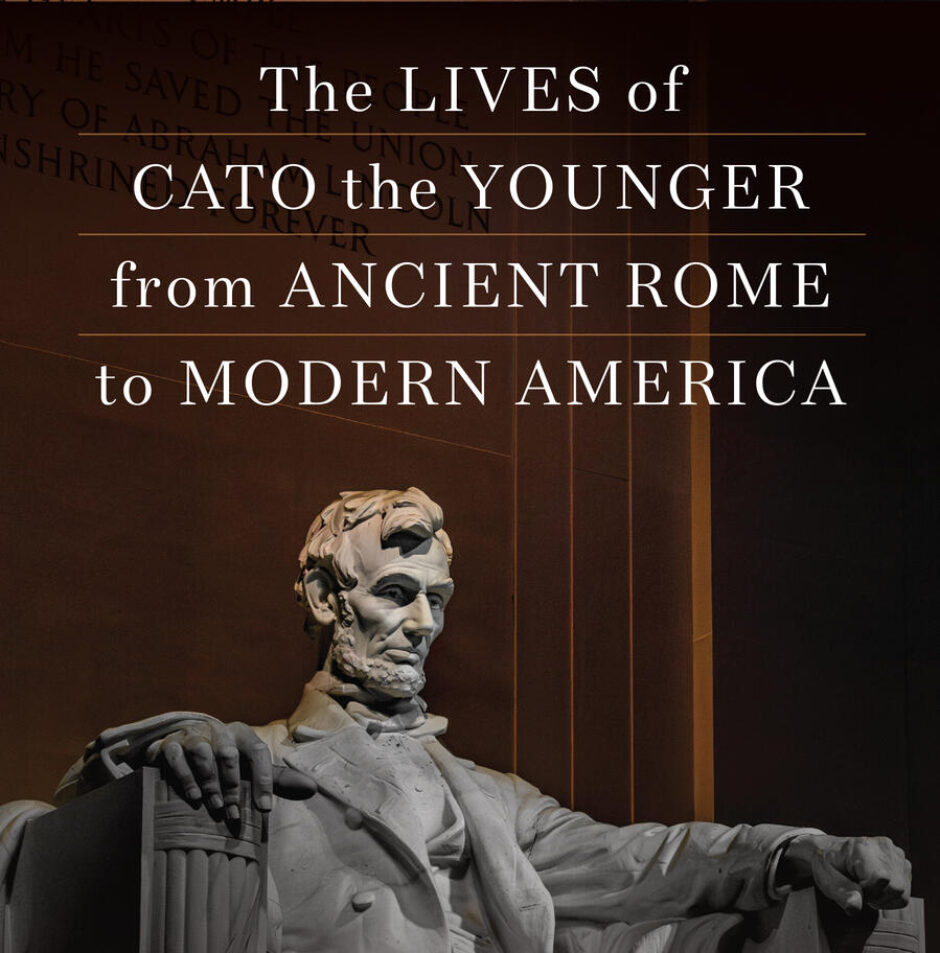
The Lives of Cato the Younger from Ancient Rome to Modern America traces the reception and influence of Cato from his suicide at the fall of the Roman Republic to the twenty-first century. In preferring death to Julius Caesar’s dictatorship, Cato became a symbol of resistance to tyrannical rulers during the Roman Empire. In the years that followed, three interpretations of Cato became predominant: Cato lived and died with the resolve of a philosopher; he was a traitor to Caesar’s legitimate rule; or he was a republican statesman defending liberty. Beginning with these interpretations, Thomas E. Strunk explores Cato’s reception in antiquity with chapters on Tacitus and Plutarch; and he later discusses medieval Christian writers such as Augustine, who considered Cato’s suicide sinful, and Dante, who made him the noble guardian of Purgatory. In Europe, playwrights composed dramas on Cato’s death that ignited the revolutionary spirit of the age, later inspiring American General George Washington and his soldiers. Abolitionists such as Frederick Douglass invoked Cato and his revolutionary spirit, yet after the American Civil War, Cato’s name was appropriated as a symbol of allegiance for Confederates and their descendants, and lines memorializing Cato were inscribed on the Confederate Memorial at Arlington Cemetery. As the first book to provide an in-depth study of Cato and his lasting influence, Strunk’s study seeks to explore the contemporary nature of his principles and their influence on present-day American politics.
“This is an important book for the moment and one that will contribute to vital conversations far into the future. The Lives of Cato takes up an iconic piece of the Classical legacy and places it before the reader in all its glory and warts, thereby showing that humanistic scholarship in the Classics, far from being irredeemably tainted, let alone dead, has much of real value to contribute to contemporary debates.”
– Trevor Luke, Florida State University
“Exhaustively researched and meticulously argued, The Lives of Cato the Younger from Ancient Rome to Modern America illuminates the importance of reevaluation of the past in order to understand one’s present. Through Cato, Strunk highlights the perils and possibilities of using ancient examples to frame historical and continuing discourse concerning republicanism, the defense of individual liberty, and opposition to authoritarianism.”
– Jonathan Zarecki, University of North Carolina Greensboro